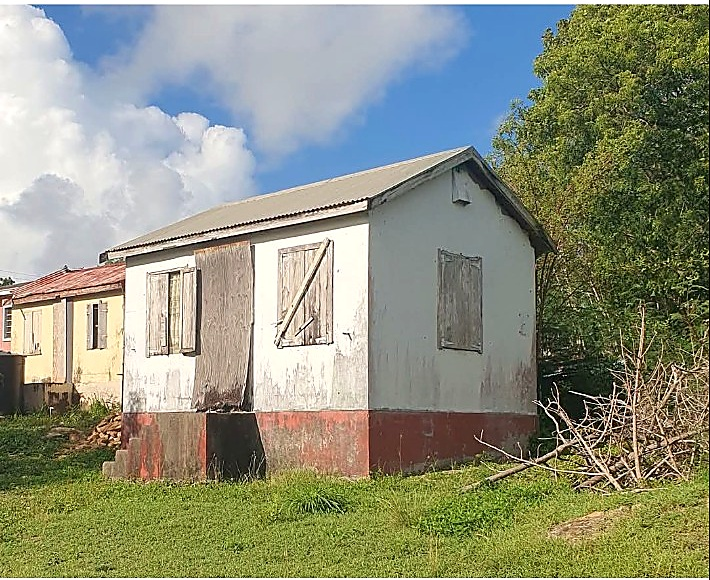
Drive through Antigua's villages and sooner or later you begin to notice them: small, simple houses, often built from concrete blocks, with familiar proportions and a shape that seems to repeat from one community to another.
Some are carefully maintained. Others have been extended, renovated or changed almost beyond recognition over the decades. At first glance they hardly look like historic landmarks.
Yet these modest little houses tell a remarkable story about ordinary life in Antigua.
The story began before the hurricanes.
It is tempting to look at these houses and assume they were all built after one particular hurricane. The real history is more complicated, and considerably more interesting.
By the end of the 1920s, housing conditions for many working families in Antigua were extremely poor. In 1929 Britain passed the Colonial Development Act, creating a new system for financing development projects throughout its colonies.
Modern historical research identifies a housing project in Antigua as the first project funded under the new Act. Antigua therefore became an early testing ground for a difficult question: how could better housing be provided to working families at a price they could afford?
The early schemes were not simply houses handed out free of charge. Historical accounts refer to hire-purchase arrangements, allowing working-class households to occupy government-supported homes and gradually acquire them.
Then came 1950.
Antigua was struck by a major hurricane in August 1950. Only days later, another severe storm followed.
The destruction was enormous.
A housing problem became a reconstruction emergency.
A long-term shortage of suitable housing had suddenly become a major reconstruction challenge. Authorities planned roughly 1,400 replacement houses and developed new residential areas next to existing villages, while also attempting to reduce overcrowding.
By the end of 1956, historical records reported 1,413 houses being rebuilt under the Hurricane Rehousing Programme.
Aided self-help: building together.
Reconstruction was not simply a matter of government contractors arriving and handing over finished houses.
An approach known as aided self-help became important. Families and communities contributed their own labour, while government authorities and specialists provided organisation, technical knowledge, access to materials, land assistance or other forms of support.
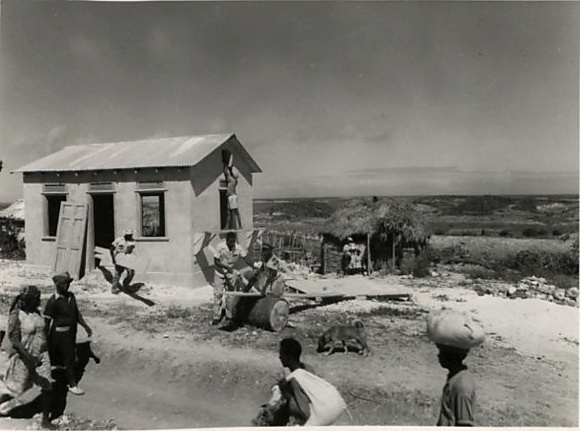
One historic photograph makes this story unusually tangible.
“Cement block House at Willikies Village. Built by the aided self-help method. This is to replace the hut in the background.”
The photograph comes from the British Colonial Office collection. Behind the new cement-block house, the older dwelling it was intended to replace can still be seen.
Few documents show the transformation in living conditions quite so directly: two types of home, standing together in the same photograph.
The ideas did not come only from Britain.
Antigua's housing story also forms part of a wider Caribbean history.
Puerto Rico had developed significant experience with low-cost self-help housing by the early 1950s. Historical United Nations records document cooperation between Puerto Rico and Antigua, including assistance from Puerto Rican housing specialists.
Antiguan personnel were exposed to aided self-help methods, and ideas about construction, social housing and community involvement travelled between islands and governments.
These houses therefore belong to something much larger than a purely British colonial rebuilding programme. They are also part of a Caribbean exchange of practical knowledge about how ordinary families could obtain safer and better homes.
So are all the little houses “hurricane houses”?
No.
And this is where the story needs a little care.
Antigua already had government-supported housing initiatives from the early 1930s. Later came hurricane reconstruction, aided self-help programmes and further housing initiatives.
Individual houses were also altered, enlarged and rebuilt over time, while similar designs may have been copied privately.
Appearance alone does not prove a house's history.
No original plan has yet been located in the digitised historical sources that would allow every surviving small concrete house in Antigua to be confidently assigned to one particular official programme or building type. The original roofing specification of the particular house type also remains uncertain.
That means it would be misleading to point at every similar building and declare it a 1950 Hurricane Rehousing house.
Some certainly belong to this broader period and history. But the surviving buildings have lived lives of their own, just like the families who occupied them.
What remains today.
The little houses are not meaningless background scenery.
They tell us how Antigua dealt with poverty, overcrowding, catastrophic hurricane damage and the need for better housing during the twentieth century.
They tell the story of families gaining access to homes of their own, communities contributing their own labour to reconstruction, and ideas travelling between Antigua, Puerto Rico, Britain and the wider Caribbean.
Some have disappeared. Some have been extended until their original form is barely visible. Others still sit beside the road, modest and easily overlooked.
So the next time you drive through an Antiguan village and notice one of these little concrete houses, it deserves a second look.
History in Antigua is not found only in forts, sugar estates and grand colonial buildings. Sometimes it is sitting quietly beside an ordinary village road.
About this story
This Antigua in Focus feature is based on historical research using academic work, British archival material, United Nations reports and contemporary records of Antigua's housing and reconstruction programmes.
- Richard Harris, “Making leeway in the Leewards, 1929–51: The negotiation of colonial development.”
- Colonial Development Act 1929.
- United Nations reports on the Leeward Islands and Antigua's post-1950 hurricane housing programme.
- UK Parliament, Hansard, “Storm Damage, Antigua (Relief),” September 1950.
- The National Archives (UK), Colonial Office photograph CO 1069/413/5, Willikies Village.
- United Nations documentation of housing cooperation between Puerto Rico and Antigua.